
Before you are a leader, success is all about growing yourself. When you become a leader, success is all about growing others.
Jack Welch
Leadership is a word we continually hear: political leader, company leader, family leader. In the corporate world, we often associate leadership with management and even use the two interchangeably. We assume that anyone in a high-level position is automatically a leader. We think titles make someone a leader. We believe that the corner office defines leadership.
But is that really true? What makes an individual an exceptional and influential leader? What are the common traits a leader should possess? And are we born as natural leaders?
In this article, I would like to explore the DOs and the DON’Ts of what a true leader should be.
As Arnold H. Glasgow once said: “A good leader takes a little more than his share of the blame, a little less than his share of the credit.”

- I – Inspire: Spark ideas in others and encourage them to turn their ideas into reality.
- M – Motivate: Encourage others to never give up despite challenges or setbacks.
- P – Positive Influence: Be a role model and behave in a way others want to emulate.
- A – Action: Drive change by taking action today.
- C – Change: Be the driver of transformation.
- T – Trust: Build trust with authenticity, consistency, and honesty.
A true leader’s job is to inspire, motivate, positively influence, take action, implement change, and build trust among their peers.
I have worked with many managers over the last 10 years of my career, but not all of them qualified to be called leaders. Managers’ job is to follow protocol, serve the company’s purpose, give orders, implement processes, and put the company’s success above all. Their job is not necessarily to make a long-term impact or change the world. It is more about generating profits, exceeding company expectations, meeting deadlines, and hitting performance metrics. It is no surprise that individuals in a company can feel replaceable and seen as just numbers.
Leaders, on the other hand, believe in the potential of those they work with. They see talent, push people to think outside the box, encourage sharing ideas, and foster growth. A true leader behaves with integrity, transparency, and consistency. A strong leader doesn’t build followers but develops more leaders. They create an environment where collaboration is encouraged, ideas are welcomed, and individual performance is valued.
As Ralph Nader said: “The function of leadership is to produce more leaders, not more followers.”
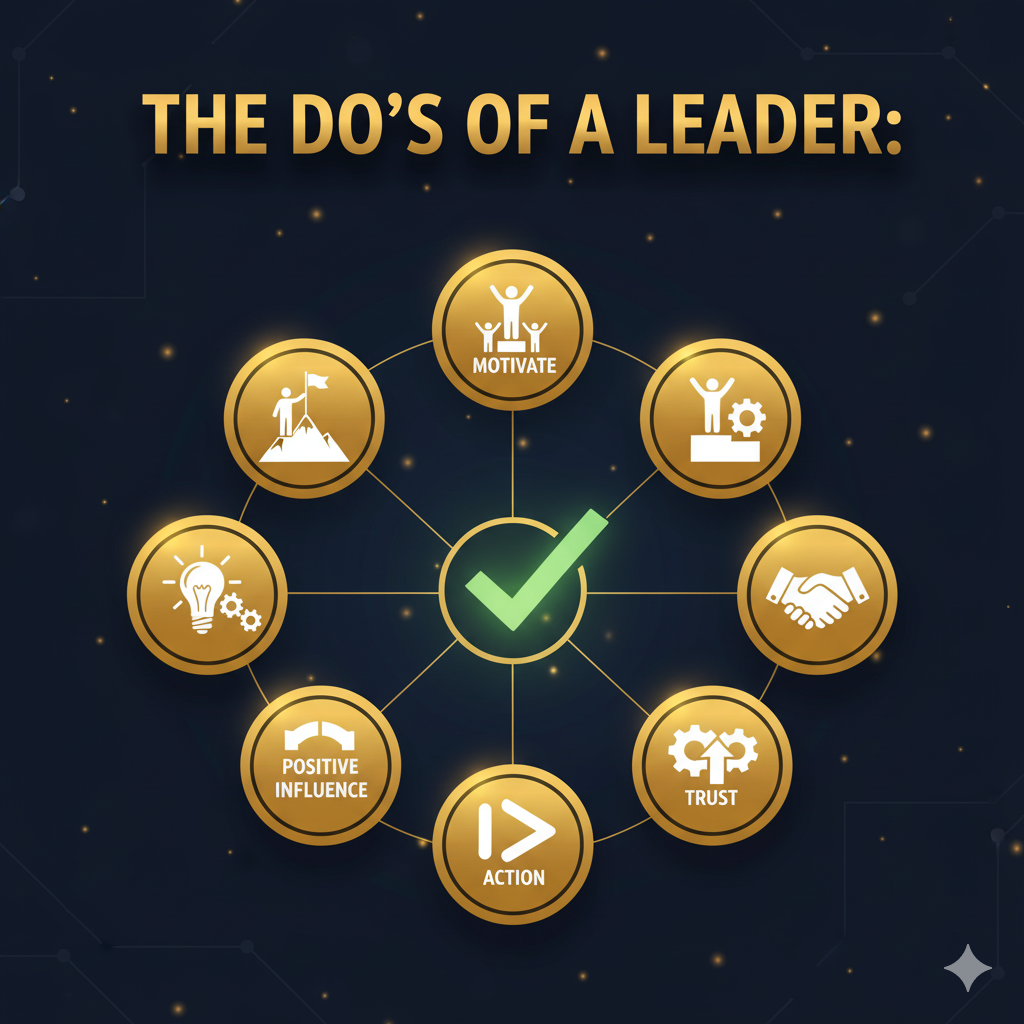
The DO’s Of A Leader:
- Lead by Example – Behave in a way that inspires others and sets a model for them to follow.
- Communicate Openly – Ensure ideas and changes are communicated clearly, promptly, and transparently.
- Invest in Others – Encourage growth, assign special projects, and push others to take initiative.
- Be Empathetic – Listen to concerns and adjust when possible to meet people’s needs.
- Stay Accountable – Take responsibility for mistakes and admit when you are wrong.
- Be Charismatic – Spread positive energy and carry a strong presence, even in silence.
- Be Resourceful – Share knowledge and guide others effectively.
- Be Transformational – Drive change today to create a better tomorrow. Be a go-getter who seeks solutions.
- Be Altruistic – Focus on others and the greater good, not personal gain.
- Be Visionary – Envision long-term goals, know why they matter, and inspire others to share the vision.

The DON’Ts Of A Leader:
Leadership starts to take a detour when ego and arrogance enter the picture. Big CEOs sometimes assume that their title or salary makes them true leaders. They end up instructing their teams rather than empowering them to think, create, and take ownership.
- Don’t confuse authority with leadership – Titles do not define a leader; actions, vision, and direction do.
- Don’t neglect personal growth – A true leader is humble, a lifelong learner, and constantly improving.
- Don’t take credit for others’ work – A true leader appreciates and celebrates contributions fairly.
- Don’t control – A leader delegates and trusts, instead of manipulating or micromanaging.
- Don’t put yourself first – People come first. A true leader is empathetic and people-centered.
- Don’t micromanage – Empower others instead of controlling every detail.
Reflection:
This week, take a few minutes to reflect on your leadership style:
- Write down three things you’re doing well and three things you can improve.
- Identify one inspirational person in your life—whether a friend, family member, community figure, or even a celebrity—and write down what you admire about them and why.
- Remember the saying, “Eat an elephant one bite at a time.” If you could add just one new leadership trait to yourself, what would it be? Start small, but start now.
When it comes to leadership, it is about making mistakes, owning them, and choosing growth. It is about being a lifelong learner, empowering others, and building trust.
Leadership is not about ego or titles—it is about impact, influence, and integrity.
So, I leave you with this question: Are you managing, or are you truly leading?
Recommended Resources:
- The 7 Habits of Highly Effective People – Stephen Covey
- How to Win Friends & Influence People – Dale Carnegie
- The Diary of a CEO – Steven Bartlett (and his podcast by the same name)
If you want to sharpen leadership and communication skills, I highly recommend joining Toastmasters Club, a global public speaking and leadership community.
A fantastic podcast to explore is Think Fast, Talk Smart by Matt Abrahams, which focuses on practical communication strategies.
About The Author:

URMI HOSSAIN
Urmi Hossain is a Canada-based financial services professional with CFA and CAIA designations, as well as a self-published author, speaker, blogger, polyglot, and mentor. Her book Discovering Your Identity reflects her third-culture upbringing. She advocates for women’s empowerment through roles with Women in Leadership and Femme Influence, is an active Toastmaster, and enjoys thrillers, boxing, HIIT, and running.
Disclaimer: The views, thoughts, and opinions expressed in this article are solely those of the author and do not necessarily reflect, whether in whole or in part, the views of The Open Chest Confidence Academy, its owners, directors, management, employees, subcontractors, partners, affiliates, clients, or members.